This article is adopted from The Odin’s Project Motivation & Mindset. Though the two projects deal with different goals of programing and engineering, learners can find helpful guides in the intersection of both realms.
Introduction
Regardless of the major that you will get into, learning engineering is difficult but rewarding. In this article, we will go through what you will expect as you are starting your journey in engineering education, along with factors that would help you success in engineering and what you should avoid.
Motivation
There is a wide range of reasons why a student may choose engineering:
- Do you want a fulfilling career that pays well?
- Are you fascinated by problem-solving?
- Or, do you want to get rich and buy three trampolines? (yes, someone literally gave me that answer)
Whatever the reason is, we recommend holding on to your motivation and comeback regularly to it. It will pull you through the finish line.
The Learning Process
Your first year at the College of Engineering will be a marathon. We hope that student can make the most out of it and not burn themselves out.
When it comes to learning, there are two learning modes that you want to differentiate, Focus Mode and Diffusing Mode. In Focus Mode, you are actively learning. You switch to Focus Mode when you are listening, taking notes in class, or reading this. Diffusing Mode is switched on when you are not actively learning, like doing dishes, the laundry, exercising, or cooking. Believe it or not, your brain is still learning in the background even when you are resting. It organizes information and store them for long-term use. It is important to know that your mind goes through these two modes as the process of learning.
So the next time you feel tired looking at a screen, or a book, take a short break and be assured that it will actually help you. On campus, there are many resources that can help, including joining a student organization, getting to a study group, or taking a stroll in Aggie Park.
In short, you would want to understand it, practice it, and teach it.
To understand the materials, we recommend coming to class with questions, utilizing the Peer Teachers and professors office hours, and asking questions on the TAO discord server.
To practice it for exams, we recommend zyBook and past quizzes. For more exciting projects, you can start your own or join an engineering club on campus.
To teach the materials, we recommend getting together in groups to study and teach each other, or becoming a peer teacher upon finishing the course.
What to do when you are stuck
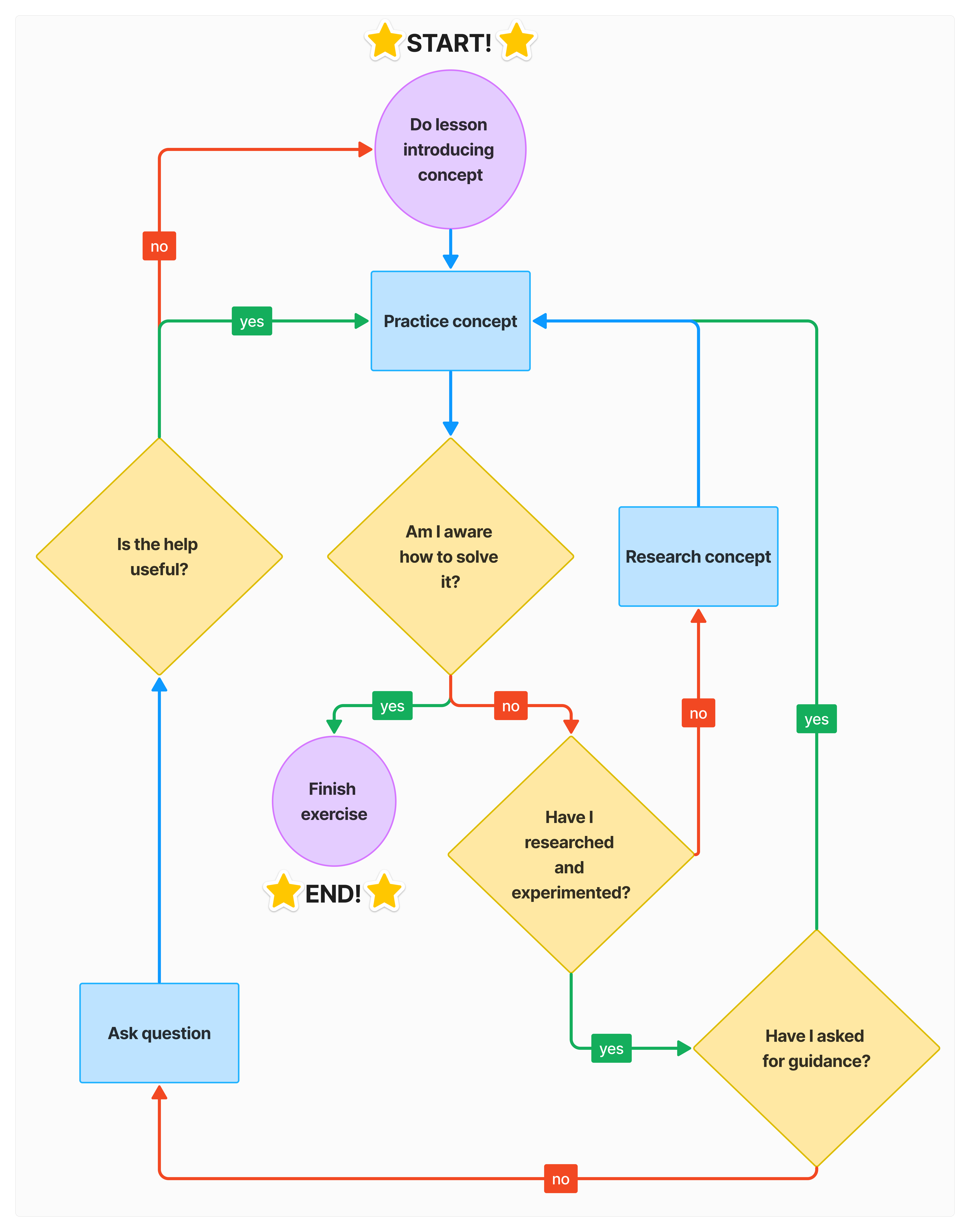
There are several tools you can use when you are stuck:
- Take a step back and investigate your code: sometimes it is a quick and easy fix like a syntax problem.
- Research it on the internet: it is very likely that other people have run into the same problem. Note that even though you are inclined to look over AI response in your search, you should not use AI in ENGR 102, or 216. We will go through AI usage in the next part.
- Take a break: take advantage of your diffusing mode.
- Ask your PTs or professor for help, or visit them during office hour: we are here to help you.
The Odin project also has a good graph for you to consult when you get stuck:
On AI generated work
Your curriculum should highlight this in more detail, but in short, you should not be using AI for your work in any of the Freshman course (unless specified to do so, some professors have homework that will need you to use AI). The goal of the course is to introduce and let you practice an engineering mindset. This involves deeply understanding the principles of basic Python. Using AI might help you complete assignment quicker, but you will not understand and retain as much as learning it yourself.
Only 2% of cheating in college are reported. Do you know what happens when an incompetence engineer goes into industry?
The Odin Project also has a good section about using AI as a learner. We encourage you to take a look at that section on your own time.
Managing your study time
You are in college and is likely juggling many challenging subjects at once. It is important that you manage and use your time wisely. We recommend using a time management tool like Google Calendar so you can visually arrange your tasks, set reminders, and block out specific time blocks for class or self-study. For ENGR 102, Canvas assignments links to your Google Calendar once set up correctly. It is a handy tool to keep you organized and stay ahead of due dates.
For the sequences of ENGR 102, 216, and 217, many student reports time in-class in not enough for them to fully understand concepts, so doing your reading and practice on your time is the utmost important thing to success in these classes. It may take you longer to grasp concept or it may take you less time. It does not mean that you are smarter or dumber than other people. It only means that you have different starting points and experience. People growing up around engineers or simply have taken a coding course in high school have more advantages in these courses, but it does not mean that you can’t learn those skills.
In short, don’t worry too much, manage your time and go learn.
Pitfalls to avoid
Not taking breaks
As you move forward into the course, you may feel compelled to work and study for long hours. It first, it may seems like you are getting more done, but this often leads to burn out, and hold you down even more.
Taking frequent breaks throughout your days help you brain retain more information, and switch to diffuse mode like we discuss before. We recommend you follow the pomodoro technique to help you pace your study.
An important point to note that because the majority of your study involves looking at a screen, it is helpful to take some time off it during your break. We recommend:
- Go for a short walk
- Journal
- Listen to some music
- Grab a drink
Rabit holes
The courses on your first year will scratch the surface of many topics. You may want to delve deeper into those topics, but we recommend you stick to the curriculum and try to keep up. You will fill in the gaps once you get into your major.
Digital distractions
If you have taken a look at the pomodoro technique, you might have noticed that your focus time are usually clearly defined with spaced breaks in between. That is why it is important that you protect your workflow from distractions to maximize your productivity during those slots.
The most common distractions are from your computer or your phone. Try to minimize those distraction by:
- Turning off unnecessary notification
- Keeping your phone out of reach
- Set time limits and focus mode
Additionally, Elliot Clowes has an excellent blog post about how stop checking his phone all day. We recommend you check it out.
Physical distractions
Physical distractions are from your surrounding environment when you are studying, such as TV, other people talking, or Northgate on a Thursday night. There are several spots on campus that offer a quiet studying space:
- Zachry Huddle Rooms
- Evans Library
- Library Annex
- MSC Flag Room
- Student Computing Center (SCC)
- The Commons LLC, if you live at one of the South campus dorms
Counterintuitive note-taking
The decisions to take note or not is up to the learner and their learning style. However, we recommend taking notes for direct references or serve as prompts for further research. It is important that you are comfortable reading documentations, which are notes taken by some one else.
Taking excessive notes are time consuming and does more harm than good.
Up next
Now that you have the right mindset for freshman engineering. Here are your next steps depending on the course you take
ENGR 216